Climate Change
The UN Intergovernmental Panel on Climate Change tells us that the earth’s temperature has increased by 1.5C to devastating effects. The public health journal, the Lancet, stated that “climate change is the biggest global health threat of the 21st century.”
Recent demonstrations and awareness campaigns by young people, protest groups and David Attenborough have brought some response from world leaders. Politicians within the UK are declaring a state of a “UK Climate Emergency.”
At Hijaz Community, we feel that the growing issue of environmental damage and global warming needs to be tackled. It is becoming more imperative for the Muslim community to act, and become more engaged with issues of the environment.
Islamic Perspective
Taking care of Earth, our only home, is a central aspect of Islamic ethics and a true Muslim lifestyle. The example and teachings of the Holy Quran is unequivocal:
“He (Allah Almighty) is the One Who designated you as the successors of
the earth; and He (Allah Almighty) elevated (the responsibilities) of some
of you over others, according to your station (in life), so that He (Allah
Almighty) May test you with what He has bestowed upon you.” (Holy Quran 6:165)
“He (Allah Almighty) is the One to Whom belongs the command of the layers of trans-universal existence and the earth… and He has no partners sharing His sovereignty, and He has created everything and designed for it appropriate pathways.” (Holy Quran 25:2)
Islam teaches us that every thing in the universe, including our planet, has been created in a precise and beautiful manner to cater for all its inhabitants. Every single species has relied upon a perfect balance within the natural world that has enabled us all to live. Everything belongs to Allah, who is our Creator and Sustainer. He is the ultimate owner of the natural
world. We are charged with the responsibility of being caretakers of Planet Earth, our only home.
“It is He who produces gardens, both cultivated and wild, and palm-trees and crops of diverse kinds and olives and pomegranates both similar and dissimilar. Eat of their fruits when they bear fruit and pay their dues on the day of their harvest, and do not be profligate. He does not love the wasters.” (Holy Quran)
Muslims should not only appreciate that the richness of the natural world that has been created for us to reside within, but we should also be responsible with its limited resource. Conservationism and living in a sustainable, ecological way is therefore a very Islamic ethos.
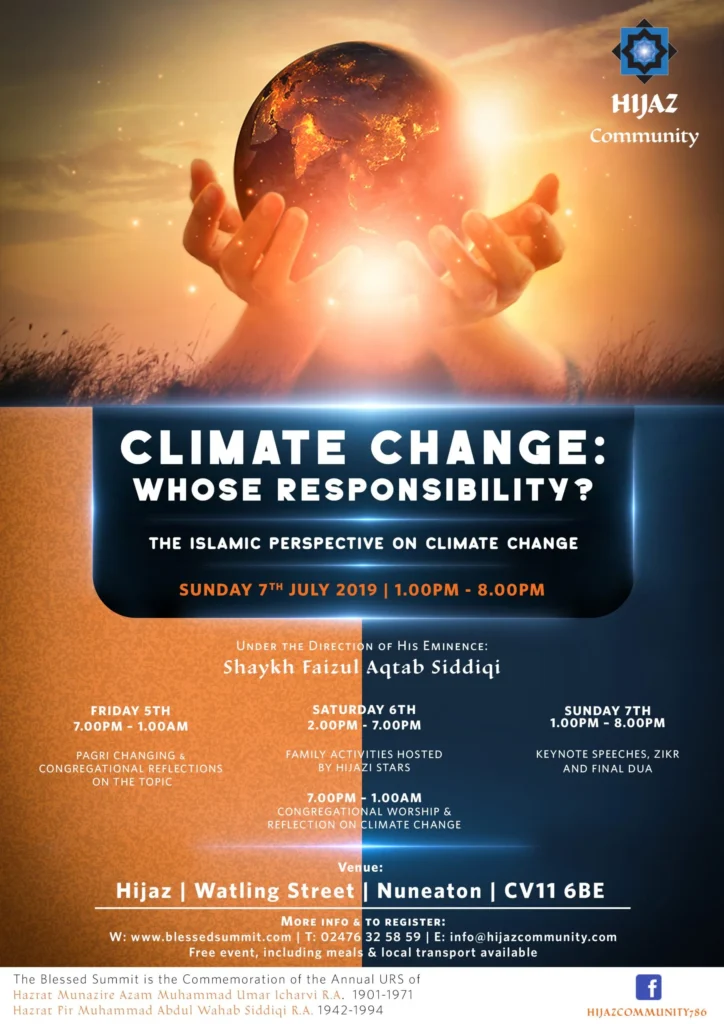
Hijaz Community invites young people, adults and families to the Blessed Summit to explore what 1.3 billion Muslims can do to help tackle Climate Change.
The Blessed Summit is a free two-day event comprising of speeches, workshops and worship focusing on developing an understanding of the true nature of man and his interaction with society.