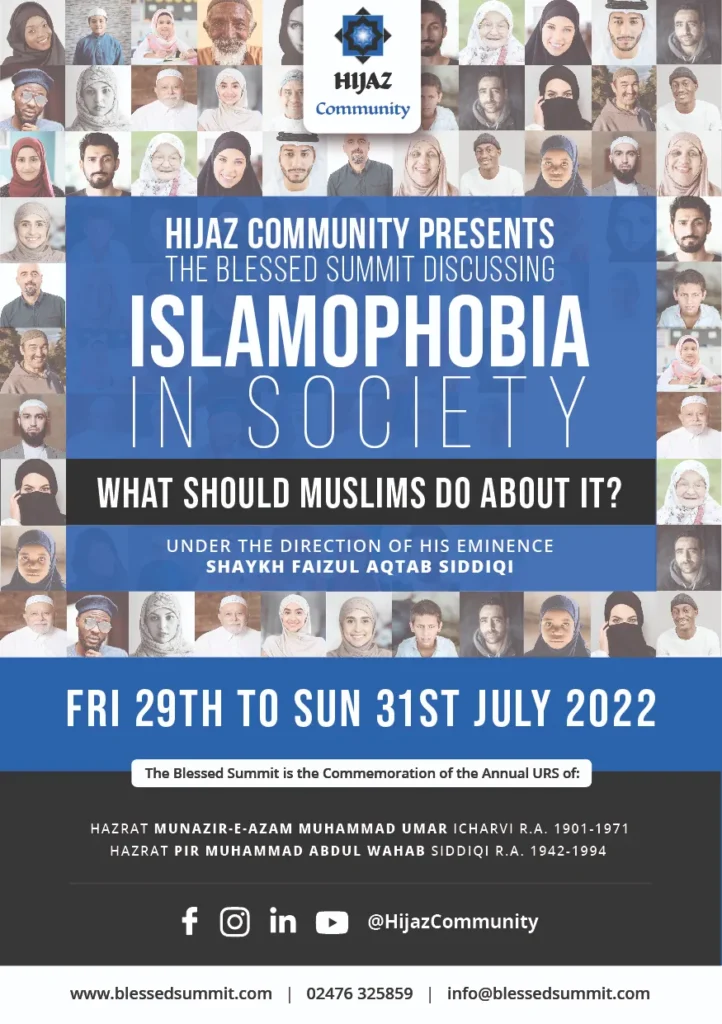
Islamophobia in Society: What Should Muslims Do About It?
Islamophobia is on the rise. We see it in everyday society and across the plethora of social media. There is a spiralling of anti-Islamic rhetoric, inciting hatred and fear-mongering. The Muslim community are collectively blamed for terrorist activity. Worse still, insulting the Holy Prophet Muhammad ﷺ is institutionalised in the name of protecting free-speech, all whilst branding Islam as a faith that is incompatible with a Western society.
The Muslim community in the UK is a unique symbol of how a variety of cultures, ethnicities and languages can have a common thread of understanding through their religion.
It was January 2011 when Baroness Warsi (the first Muslim woman to serve in the UK Government) warned that prejudice towards Muslims had “passed the dinner table test” and become socially acceptable. Her remarks provoked heated debate about tolerance and mutual respect within a multicultural society and highlighted that, sadly, prejudice against Muslims is now seen as normal.
Eleven years on and little has changed.
A University of Birmingham report, entitled ‘The Dinner Table Prejudice: Islamophobia in January 2022’, found that Muslims are the second ‘least liked’ group in the UK, and that one in four people held conspiratorial views about Shariah and ‘no-go areas’ in Britain.
It further highlighted that the British public is nearly three times more likely to hold prejudiced views of Islam than any other religion, and that ‘prejudice towards Islam and Muslims .. in the UK .. is much more widespread than most forms of racism’, with ‘prejudice toward Islam is more common among those who are wealthier and well-educated’.
In March 2021, the UN Special Rapporteur on Freedom of Religion or Belief, Dr Ahmed Shaheed, issued a report, Countering Islamophobia/Anti-Muslim Hatred to Eliminate Discrimination and Intolerance Based on Religion or Belief, in which it was stated, among other things, that there was an alarming rise in right-wing extremist groups propagating anti-Muslim hate online.
The report found that Muslims are frequently targeted because of visible ‘Muslim’ characteristics, such as name, skin colour and religious dress. It also stated that Muslims and Islam are depicted as cultural threats, in ways that serve to perpetuate, validate and normalise discrimination, hostility and violence towards them.
Muslim civilisations laid the foundations for humanity’s collective advancement: from astronomy to medicine, mathematics to architecture, the natural sciences to politics, philosophy, poetry and more, Islam has historically encouraged free-thinking and advancement. The Holy Prophet ﷺ himself established multi-religious, multi-racial, multi-ethnic and multi-social society, based on principles and values common to all humanity.
The theme of this year’s Blessed Summit invites you to consider the phenomenon of Islamophobia:
How can Muslims navigate a world with an intensifying rise in Islamophobia?
Is the peddling of anti-Muslim hate fuelling extremism?
Is Islamophobia experienced differently within society, across different groups and genders?
Can we fight the darkness of Islamophobia with the light of Islam?
Is there a template in Islam that can guide us in overcoming these global challenges?
Can Muslims find answers within their communities?
Ultimately, can we regain our civility, humanity and social harmony in addressing this and related issues?