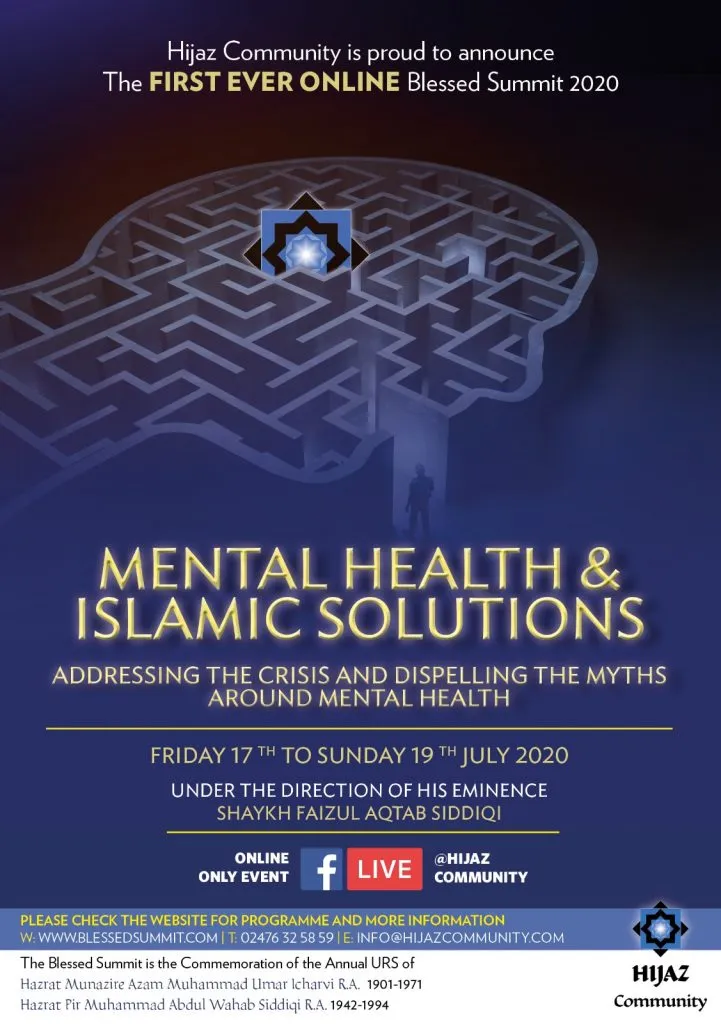
MENTAL HEALTH AND ISLAMIC SOLUTIONS
Addressing the Crisis and Dispelling the Myths Around Mental Health
The whole world is experiencing a growing mental health crisis.
The World Health Organisation gave global health estimates to be as follows:
1 in 4 people in the world will be affected by mental or neurological disorders at some point in their lives
Around 450 million people currently suffer from such conditions, placing mental disorders among the leading causes of ill-health and disability worldwide
320 million people suffer from a diagnosed depressive disorder globally
264 million people suffer from a diagnosed anxiety disorder globally
1 person dies every 40 seconds from suicide
Worldwide 10-20% of children and adolescents experience mental disorders
Half of all mental illnesses begin by the age of 14 and three-quarters by mid-20s
Depression and anxiety is much higher in women globally
Substance use disorders and antisocial behaviours are higher in men globally
This crisis has become intensified in the face of Coronavirus, a staggering global epidemic. Psychiatrists and leading experts around the world have called upon global leaders to prioritise mental health during this unprecedented time, saying that “Preventing suicide needs urgent consideration.”
Mental health problems are often a hidden and debilitating illness made worse by the taboo of society’s reluctance to talk about uncomfortable or difficult topics. Such stigma in many communities often worsens the problem and can lead to very extreme consequences, such as self-harm, suicide, poor quality of life and anger management issues resulting in domestic violence. Muslim communities (including South Asian, African and Middle Eastern) suffer from a similar taboo of not confronting the diseases of the mind in a practical and constructive way. Too often families trivialise serious mental health illnesses, or make up their own outlandish false diagnosis of the person who is suffering from a serious illness as being possessed by spirits or jinns. This can lead to extremely dangerous consequences for those suffering from specific conditions and prevents them from getting the help they really need.
In Islam, keeping the mind healthy is as key to a person’s wellbeing as keeping their body and spirit healthy. Within the Islamic tradition and teachings there is much to be explored about how to find solutions to underlying mental health problems.
Hijaz Community recognises that there are solutions within Islam as well as the medical field to bring each person to a healthy equilibrium, mind, body and soul. In the Holy Quran we are told:
“Those people who are Believers, and attain serenity of their hearts with the remembrance of Allah (Almighty); Indeed, it is only with the remembrance of Allah (Almighty) that (one can find) the peace of mind and heart.”
Surah Al Ra’ad (13), verse 28
Thus, Islam provides ways to overcome internal mental anguish and the difficulties of mental health problems.
Hijaz Community invites young people, adults and families to the Blessed Summit Online to explore what 1.3 billion Muslims can do to better understand and help tackle the Mental Health crisis.
The Blessed Summit is a free three-day event comprising of speeches, workshops and worship focusing on developing an understanding of the true nature of man and his interaction with society. This usually takes place in the blessed sanctuary of the Hijaz Site. However, due to the Coronavirus outbreak, in accordance with social distancing guidance, the safest option is to live stream to our congregation online during the intended date.